|
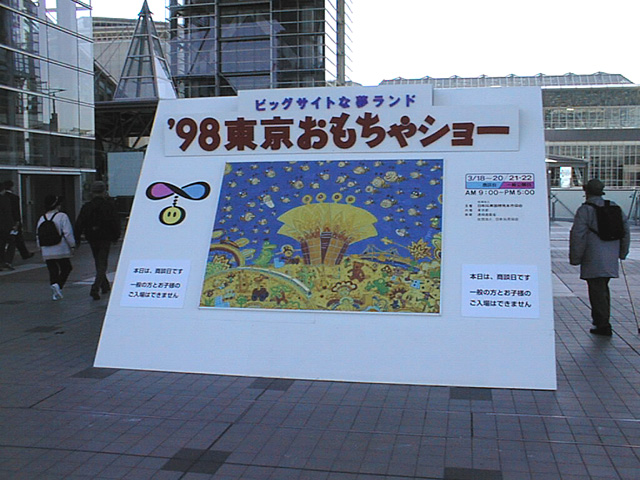 Venue: Tokyo Big Sight
The '98 Tokyo Toy Show, where toy manufacturers from Japan and abroad gather to exhibit their new toys, has been held at Big Sight since March 18. The show will be open to the public on the weekend of March 21-22.
A brief description of the trends at this year's "Toy Show" is Zuhri! They can be categorized as follows.
|
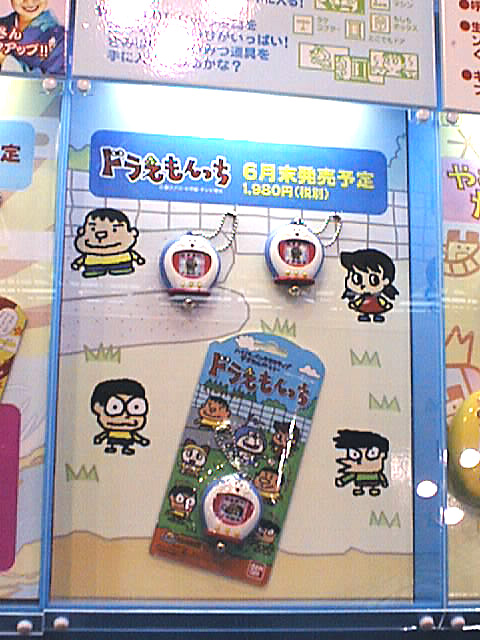
| "Doraemonchi" is also cute in shape. |
The first, after all, is the Tamagotchi series, owned by Bandai, the original mobile mini-game company. The new series has been introduced one after another, and sales seem to be steadily increasing, despite the concerns of "Will they be able to handle it? Despite such concerns, sales of Tamagotchi seem to be growing steadily.
Looking at the series of products exhibited at this year's show, in addition to legitimate developmental series, there are quite a few existing character products features. One of them is "Tamaocchi", which is the manager of Tamao Nakamura, whom many of you may already know. Since it features the popular Tamao Nakamura, it seemed to draw a lot of interest from visitors. The "Doraemonchi" is scheduled to go on sale in late June. It is shaped like Doraemon's face, with a liquid crystal display for his mouth. The game is to take care of Doraemon and put him in a good mood. When Doraemon is in a good mood, he will ive you secret tools, which you can collect. The shape is also cute, so I think it will be quite popular. Also on display was the "Yasashii Tamagotchi", a slightly larger (49mm) stationary tamagotchi.
And the product that Bandai is paying the most attention to is the "Digital Monster" or "Digimon". Bandai has put so much effort into this product that it was the first item featured in a presentation to vendors, and it is clear that the company intends to make it the next mainstay of the Tamagotchi line. Ver. 1 through Ver. 3 are currently on sale, and Ver. 4 will be released in May.
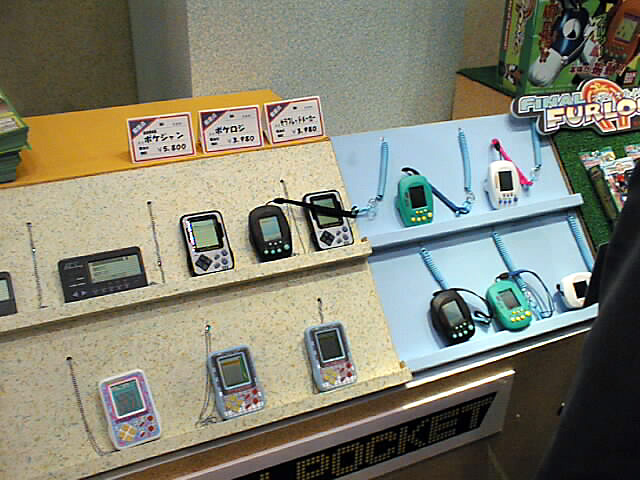
In the digital monster family, a new product called "Obakido" is in the works. Like Hudson's "Tekketsu Angel" and Nintendo's "Pocket Pikachu", it is a game machine with a step-counting function. The game is to complete the "Obakido File" by catching yokai scattered all over Japan. Of course, it is also possible to play against other yokai you have caught. The game is played by walking around Japan in search of yokai, and this is where the number of steps is calculated. There are two versions of "Obakido", "Yokai Road" and "Kai Road" and of course the yokai that appear in each version are different. This is like Pocket Monsters. It will be released in July for 3,500 yen.
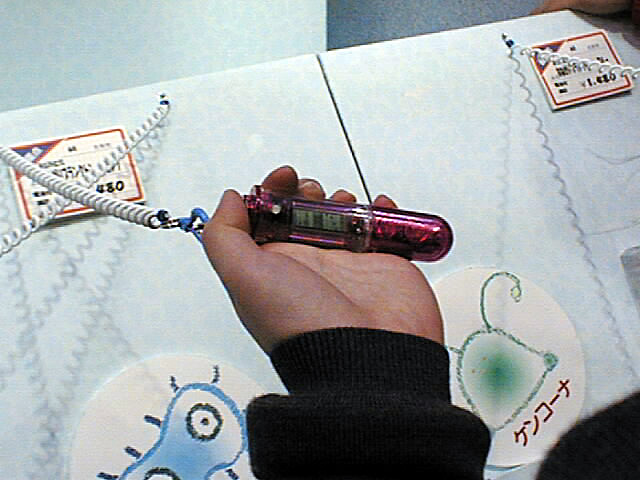
At Bandai alone, there were still a number of noteworthy games on display. One is "Onegai Plankton", which will be released in June. The shape is long and thing like a mechanical pencil, and one end can be knocked like a ballpoint pen. The game is played by clicking the pens at the right moment to catch the plankton and make them evolve. The key point of this game, however, is that the "happy points" obtained from the evolution of the plankton can be used to tell fortunes. Of course, the game is aimed at female office workers and high school girls.
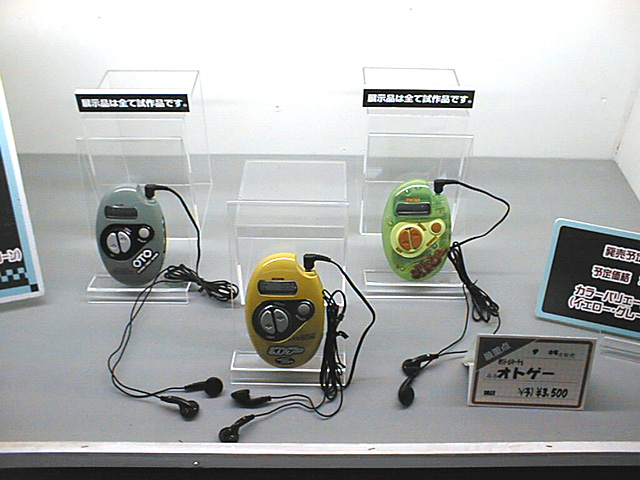
The other is "Otoge", an unprecedented portable game that will be available in September. As the name implies, this product has no LCD and is played with headphones, using only sound. The enemy is, quite simply, the sound itself. The "otoge" is in two-channel stereo, and when heard through headphones, it sounds as if the sound source is moving back and forth, left and right. The player judges the position of the object by sound alone, and then tries to knock it down. There are 48 different voices available, ranging from "UFOs" to "drunken old men" to "H-ish girls," so you will never get bored of the game. I'm sure you won't get bored of it. The game is quite addictive, although I feel that it could be a little more elaborate. But it is the kind of game that Ken Ii would come up with.
Of course, not only Bandai, but also various manufacturers, especially Sega and general toy manufacturers, are focusing their efforts on this portable mini-game market. Among many such sub-par products, Hasbro exhibited an interesting game machine. "K1 Grand Prix" is a simulation game in which players compete to become the best at standing up in a fight in a popular martial arts game called K1.
Players become trainers, training and strengthening their players. Of course, the most fun part of the game is the tournament format, in which players can connect their game consoles and play against each other: if A, B, C, D, E, and F...... are connected, the tournament format would be A vs B, C vs D, E vs F, and so on, with the winners fighting each other again (A vs C, E vs G, etc. if A and C win).
Three of K1's most popular fighters will appear: Peter Aerts, Mike Bernardo, and Andy Hug. Andy Hug does a proper heel drop!
From what we saw at the toy show, it looks like a number of portable mini-games will appear again next year.
 |
 |
 |
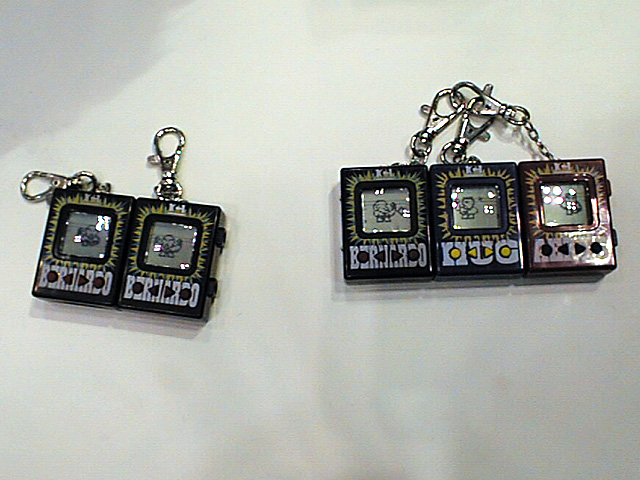 |
| Many of the people actually playing were girls. | Personally, I'm a big fan of "otoge". But from the other end of the spectrum, he might be weird. | Sega, Takara, Hiro, and other manufacturers are putting considerable effort into this genre. The photo shows Bandai's corner. | Up to 16 pieces can be connected to Hasbro's "K1 Grand Prix." |

|
| Media Girls are also enthusiastic about Virtual Masters. |
Follow the yo-yo! Not exactly a yo-yo, but this time there was a kendama "Digiken" on display, which makes full use of the latest digital technology. This Kendama is quite interesting. The body is see-through, and there is a button at each place that receives a ball, which glows and makes a sound when the ball is properly received. This alone is not much, but this Kendama is different from previous Kendama in that it has a new function to play along with music. The player plays the kendama to the music played by the kendama, and tries to clear the game in time with the rhythm of the music. If the player failed, a buzzing sound would be heard, and it sounded quite fun.
 |
 |
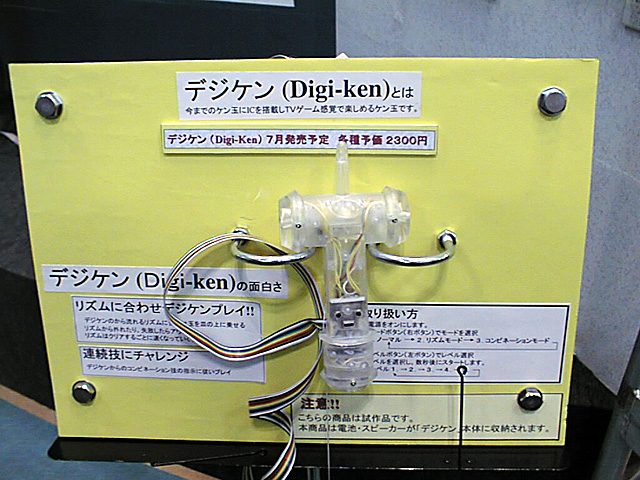 |
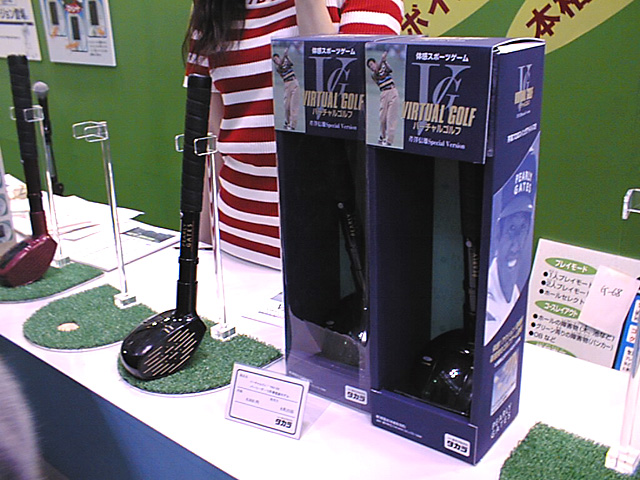
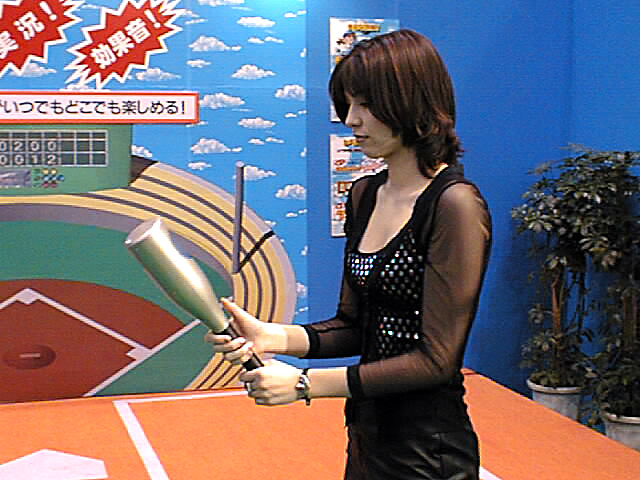
| "Virtual Golf". Now you can enjoy a game of golf while waiting for the train on the platform! | "Virtual Baseball" for a fairly authentic baseball game, scheduled for release in July. | "Digiken". A digital Kendama that is lightweight for its full of high-tech features. Is digiken the next fad? |
This section continues to thrive, but its product mix is almost exclusively for girls (or rather, 100% girls' toys). It seems that girls are more interested in toys that are a little taller than boys. Takara, Bandai, and Sega caught our attention in this area. "Kids Computer Pico" seems to have been released in a steady stream, and there were quite a few software products on display, including those from other companies.
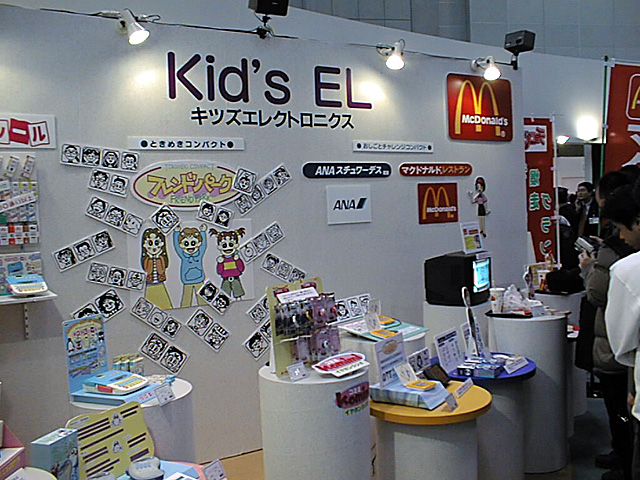
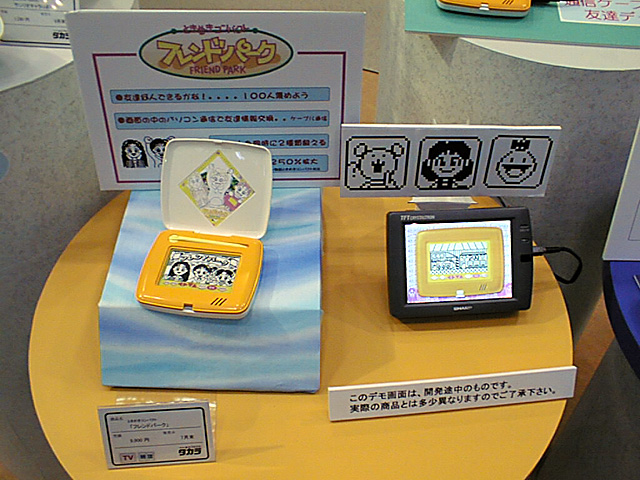
Takara's booth had a fairly wide variety of products. Trends included an electronic organizer with scheduler function, online data communication, and pet raising and exchange. An interesting product was the "McDonald's Restaurant", which allows visitors to experience serving customers at McDonald's. Is even playing house these days digital? This series also includes "ANA Stewardess", so maybe it is a popular series.
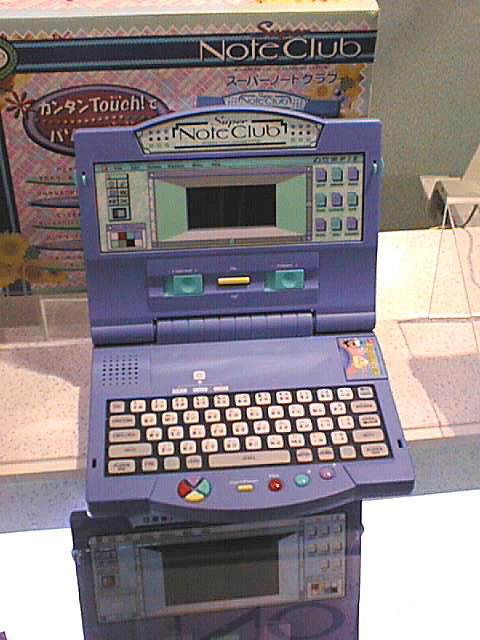
At the Bandai booth, the popular kids' computer "Super Notebook Club Mew" was on display. The LCD screen is considerably larger and appears to be more user-friendly.
Incidentally, there were almost no products using infrared communication, which was once popular. The manufacturer commented, "Since it is for children, it is prone to errors unless it is a more reliable communication transmission. Furthermore, "Even adults hardly use such a function." ...... I see.
 |
 |
 |
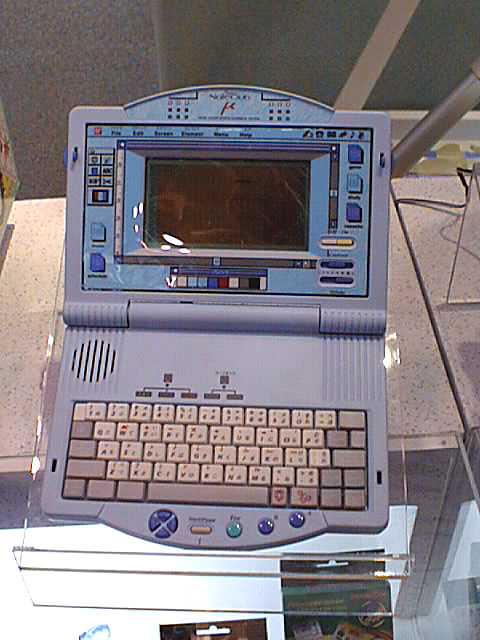 |
| Takara's kids electronics-related corner. Visitors' interest was high. But they are quite expensive toys. | This is the "McDonald's Restaurant". It's a genre that girls seem to like. | Bandai kids computer. Isn't this design ...... the same as an adult? | They are even paying attention to the keyboard layout in the latest models. Why don't computer manufacturers take a cue from usability? |
 |
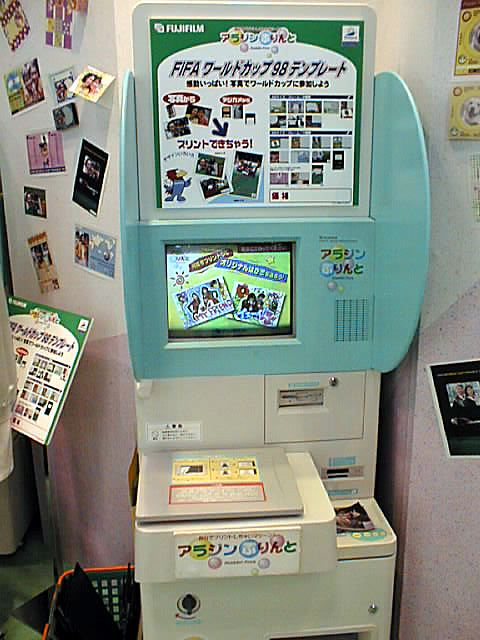 |
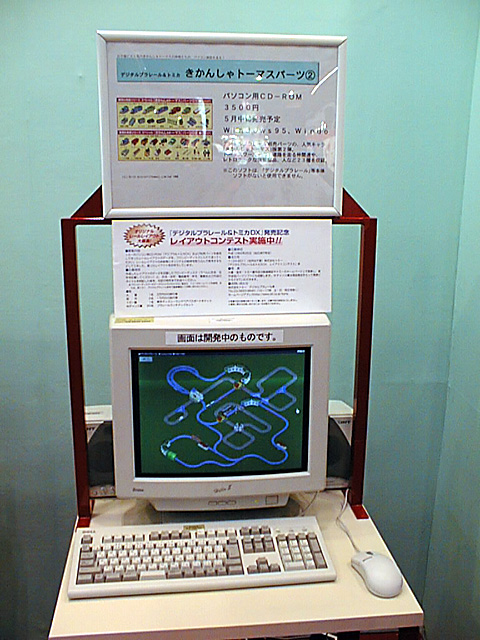
| After "Digital Plarail & Tomica" was released in April, "Thomas the Locomotive" is also available as an additional data collection. | "Aladdin Printer". It is expected that there will be quite a long line. |
In addition, the Tomy booth was also focused on "Plarail" and "Tomica", which every small child has probably played with. Also on display was "Digital Plarail & Tomica", CD-ROM software that digitizes the world of Plarail. "Digital Plarail" and "Digital Tomica" have been sold as CD-ROM software in the past, but this time they were combined into a single CD-ROM. The CD-ROM software is compatible with Windows 95/NT 4.0 and costs 6,000 yen.
Fujifilm is also exhibiting at their booth. The company is exhibiting its "Aladdin Printer", a system that creates stickers on the spot by inputting data from a digital camera or scanning a developed photo or APS film (already developed). Various frames are available, and the system outputs Purikura stickers and calendars in about two minutes. Digital camera data can be stored on Smart Media or PC Card (even Compact Flash is possible if inserted into a PC Card). It is a little disappointing that the only supported image format is EXIF.
The booths on Saturday and Sunday will be printing for free, so if you want to make purikura stickers, why not stop by? It's expected to be crazy crowded, though.
('98/3/19)
[Reported by funatsu@impress.co.jp]